BRIGDING WORLDS JOURNAL
INTRODUCING BRIDGING WORLDS
A MEMORY
I lie on the hard earth squinting up at a dazzling full moon.
Waves of sounds puncture the silence; the chord of a guitar, retching, footsteps.
Vision after vision passes through me; destruction, death, persecution, suffering, sickness, exploitation, war, violence, famine, torture, pain…
I cry as I hold myself. I sob and gasp.
One sentence runs over and over and over and over;
‘What did we agree to? What did we agree to?”
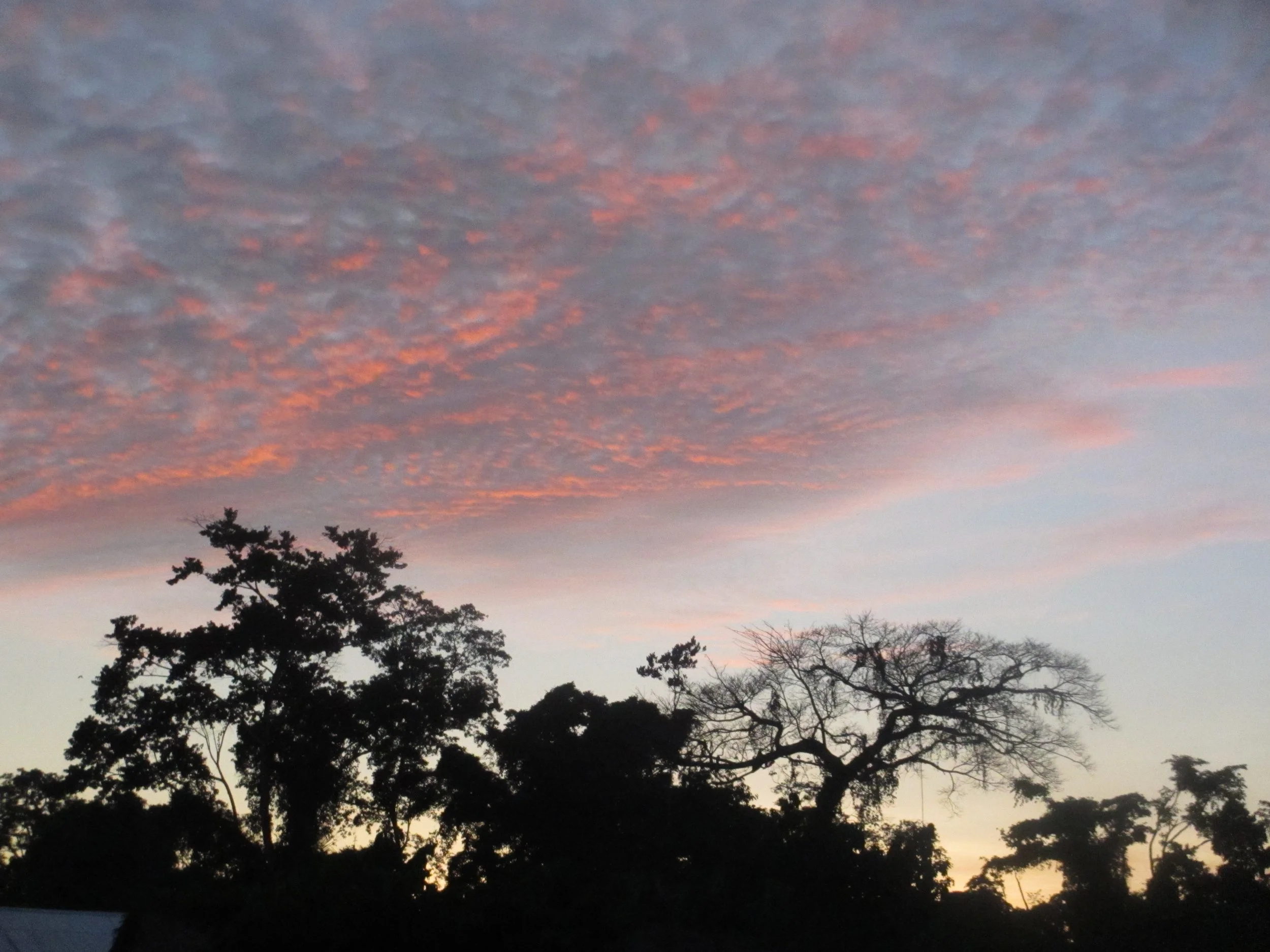
[Novo Futuro village on the Humaita River in Acre, Brazil, 2016]
Perhaps I can thank my Pisces rising, but I’ve always been drawn to the bigger questions.What are we doing? Where are we going? What’s driving us, and why?
If you’d told me fifteen years ago that spirituality would play a central role in how I relate to these questions, I would have frowned and exited the conversation as quickly as possible.
Spirituality felt suspicious and woo woo. It definitely didn’t have a place in professional conversations.
But after years working in counter human trafficking and later in the climate sector, I found myself feeling hopeless about the world. The systems I was working within felt incapable of addressing the deeper forces shaping human behaviour, suffering, and disconnection.
A decade on, global uncertainty has mushroomed; escalating conflict, climate instability, food shortages, declining mental health, AI integration, increasing forced migration…
For many of us, the bigger questions are no longer abstract. They’re becoming personal, pressing and unavoidable.
Bridging Worlds forms a response to this, not as an attempt to provide neat answers, but to contribute to making conscious the very process itself as it happens through us. A space to explore how we might hold more than one way of knowing and being in relationship.
THE PRACTICE OF HOLDING BOTH
Across cultures and wisdom traditions, there’s a shared understanding that we are more than our external form and that our psychological reality is only one layer of a much vaster field. That our existence includes subtle, non-physical dimensions, including the soul, and the continued imprints of the ancestors who came before us.
This aspect of reality is something modern culture has largely dismissed and now forgotten. I believe this has come at a great cost, individually and therefore collectively. By failing to nurture these part of our existence, we’ve shut down ways of living that maintain the relationships essential for balance, health, vitality and collaboration.
I’ve no interest in debating about which worldview is right. My concern is, can we learn to live in relationship with both?
This is where Bridging Worlds becomes a practice, as opposed to a philosophy.
It’s something I try to live, from how I meet rupture and repair in relationship, how I expand my ability to enter ecstatic states, how I grieve what hasn’t unfolded as I hoped, how I stay present to beauty without turning away from pain.
It’s the daily practice of holding the material and the mystical, the human and the sacred, without collapsing into either.
Years ago, while reading about the temple communities of Alexandria, I was overcome with a feeling I can only describe as homesickness. I began to sob uncontrollably which felt bizarre! Part of me was experiencing a deep longing to be back in the temple. Then I heard the words: “It’s the time to remember that the whole world is the temple.”
That stuck with me. To live this way asks us to include everything on the altar of our attention — the numbness and the vitality, the grief and the hope, the love and the fear. It requires courage, discernment, and choice.
Because even in uncertain times, we still get to choose where we align our energy, what we feed, where we return back to and therefore what we embody and bridge.
This for me is the way, and this journal is an offering into that space.